Please Stop Trying To Fix Your Dog’s Allergies.
I know how that sounds when your dog is up at 2am chewing her paws. But the pills, the special food, the vet visit every few weeks — I was bailing water out of a boat and never once looked for the hole. This is what I wish someone had told me fourteen months and $4,775 ago.
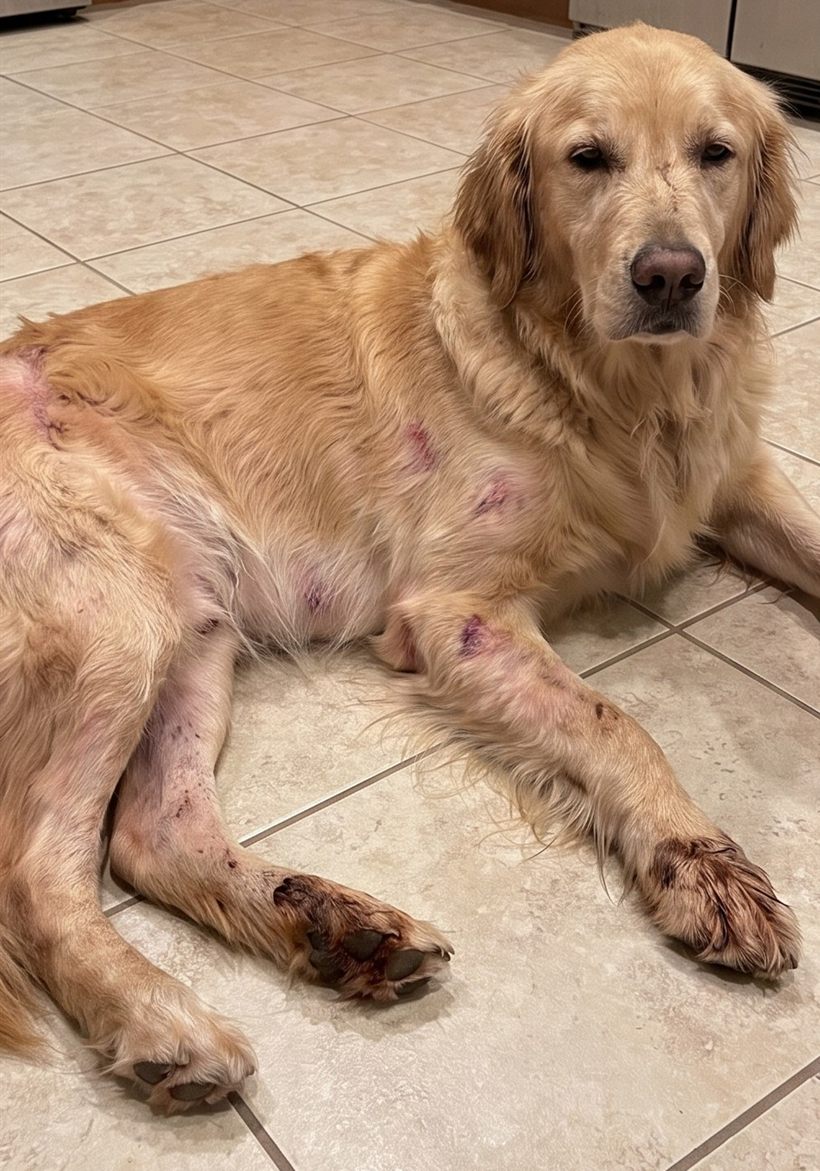
It started small.
A bit of scratching after walks. A pink patch on her belly I noticed when she rolled over for a rub. Nothing that seemed like anything.
Then, over one spring, it wasn’t small. Scratching you could hear from upstairs. Hot spots that showed up overnight. Ears that smelled like something had gone off, and paws she chewed until the fur between her toes turned rust brown.
I’m Megan. I’m 44, I live in Columbus with my husband Chris, and Daisy is our seven-year-old golden retriever. She is the kind of dog who greets the mailman like family. For fourteen months she spent most evenings lying on the kitchen tiles, because the cold was the only thing that seemed to help.
The appointments, in order
- First visit
Let’s start her on Benadryl and see how she does.
She didn’t do anything, except sleep more. - Second visit
Okay, let’s try Apoquel. This should help.
It did. For sixteen days. I know it was sixteen because I’d drawn a little heart on the fridge calendar the first morning she slept through, like somebody who had won something. Day seventeen, it was back at full volume. - Third visit
We’ll bump the dose up.
Higher dose, higher bill, same thing about two weeks later. - Fourth visit
Let’s move her to Cytopoint. It’s more targeted.
And $165 every few weeks became normal.
It worked. For a while. But the while kept shrinking. Six weeks became five, then four, then me on the phone saying “can we come in early, it’s back.”
And everything else, all at once. Grain free, then grain in, then salmon, then a novel protein that cost more per pound than our own groceries. An allergy test that said she reacts to pretty much everything that grows outside. Probiotics, fish oil, coconut oil, oatmeal baths for a dog who hides when she hears the bath running.
Every one of them worked for about two weeks.
I added it up one night. I wish I hadn’t.
| Apoquel, 7 months | $840 |
| Cytopoint, 10 injections | $1,650 |
| Vet visits & rechecks | $585 |
| Allergy testing | $575 |
| Three food changes | $520 |
| Probiotics, oils, shampoos, baths | $415 |
| Ear drops & cleaners | $190 |
| Fourteen months | $4,775 |
And honestly, the money wasn’t the worst part. The loop was.
New treatment, then it helps, then “I think we’ve finally got it”, then it comes back, then you sink, then again.
After five or six rounds of that you stop letting yourself enjoy the good weeks, because the good weeks are what make the next crash hurt.
I honestly started to believe this was just our life now. That some dogs are like this, and we’d be managing it forever.
For fourteen months I asked the wrong question
I kept asking what treats this. I never once asked why do the treatments keep wearing off.
A friend from Daisy’s old puppy class sent me to a vet across town who books long appointments. I brought the whole folder. She didn’t open it. She asked me two questions, and I couldn’t answer the second one.
“Where is she worst?”
Paws, I said. Her belly. Inside her ears.
“And where has she never had a problem?”
I didn’t understand the question.
“Her back,” she said. “Shoulders, along the spine, the top of the hips. Anything there, ever?”
I thought about it. Seven years. Not once.
“So if this is an allergy to pollen and grass, where does that stuff land on a dog?”
On top of her. On her back.
“All over her back. Far more than ever gets between her toes. So why is her back the one place that’s always been fine?”
Think of where your dog is worst.
Now think of where your dog has never had a problem.
For nearly everyone it’s the same answer. Paws. Belly. Ears. And never the middle of the back.
The itch isn’t following the pollen. It’s following the thin skin. Every owner in every Facebook group describes the same map, and almost nobody asks why it’s always the same map.
What the barrier actually is
This is how she explained it, as close to her words as I can get.
Your dog’s skin is a barrier. A physical wall. The skin cells are the bricks, the natural oils are the mortar, and the whole wall sits on collagen. While the wall is intact, pollen, dust mites and grass proteins sit on the surface and cause nothing. The immune system never meets them.
Pollen, dust mites and grass proteins sit on the surface. The immune system never meets them.
Gaps form. Allergens pass through into living tissue, and the immune system attacks.
Some dogs are born with a thinner wall. Goldens, labs, bulldogs, Frenchies and westies most of all. Others start with a good one and lose it faster than they replace it, from years of scratching, repeated antibiotics, a poor diet, or simply getting older. Either way, gaps form. Small at first, bigger every year. Allergens that used to sit on top pass through into living tissue, and the immune system does what it’s built to do. It attacks.
That’s the scratching. The paws, the ears, the belly, the hot spots. Not four problems. One wall, failing in different places.
And it gives out first where it was thinnest to begin with: the paws, the belly and groin, the skin inside the ears. Which is exactly why the map is always the same.
Goldens. Of course.
Daisy’s immune system was never broken. It was doing its job through a wall with gaps in it.
Why the medication “stopped working”
Then I asked the thing I’d been carrying around for a year. Why did the Apoquel stop working?
“It didn’t stop working. It’s still doing exactly what it was made to do.”
- Apoquelturns the itch signal down. It’s a good drug and it does exactly that.
Nothing to the wall. - Cytopointblocks the itch signal for weeks at a time. Also a good drug.
Also nothing to the wall. - Steroidsswitch off the immune reaction almost completely, which is why they come with the drinking, the peeing and the weight.
Nothing to the wall.
Every one of those is reasonable. Not one of them touches the wall. That’s not a flaw in the medication. It’s just not what it was designed to do.
So the wall keeps thinning while you keep adjusting the alarm. More comes through every month. The same dose has a bigger reaction to hold back. That’s why it worked and then stopped. The drug didn’t get weaker. The problem underneath got bigger, faster than the drug could cover for it.
She was careful to say our old vet hadn’t done anything wrong. There is nothing to prescribe for a collagen wall. No injection, no tablet, no repeat appointment every six weeks. A ten-minute appointment is built around the prescription pad, and the wall isn’t on the pad, so it never comes up.
I thought about the ledger. Fourteen months, $4,775, and every dollar of it went on the surface of my dog or the reaction of my dog. Not one dollar went on the wall.
Itchy skin is the smoke, not the fire. I’d been paying for the smoke.
“But I’ve already tried collagen.”
I actually laughed at that point, and not nicely. There was a tub of collagen chews in our cupboard that Daisy had been eating for five months. Nothing.
Her answer is the part I’d most want you to read, if you’ve been there too.
- A chew or a powder has to survive the stomach, and most of it doesn’t. It gets broken down and digested like any other food long before it gets anywhere near the skin.
- Anything solid was heated to make it solid. Heat damages protein. You can’t un-boil an egg.
- What does get through is hydrolyzed liquid collagen. Hydrolyzed means it’s already broken down small enough to absorb, instead of being digested like food. Same word on the tub, a very different amount arriving where it’s needed.
I never really tried collagen. I tried a chew, and the chew is what failed.
How I see our old cupboard now
| What we bought | Works on | Touches the wall? |
|---|---|---|
| Shampoos, wipes, rinses | The surface | No |
| Apoquel, Cytopoint, steroids | The itch signal | No. Never designed to |
| Elimination diets | One possible trigger, if it’s food | No |
| Chews and powders | Meant for the wall | Mostly digested first |
| Hydrolyzed liquid collagen | The wall itself | Yes. That’s the job |
Every row has plenty of happy customers, and none of them is a scam. They just answer different questions. Most of us spend years buying from the top two rows and then decide our dog is a lost cause.
What I looked for
There are dozens of these online, and every bottle has a happy dog on it. I narrowed it down with four checks.
Liquid. Not a chew, not a powder. Anything solid was heated to get that way.
The word has to be on the label. “Collagen” on its own tells you nothing about whether it absorbs.
Marine. Chicken and beef are two of the most common food allergens in dogs, the last thing you want in a skin supplement.
Easy enough to give every day for three months. A dropper on food they already eat beats a perfect formula your dog spits out.
Don’t stop anything.
Keep the medication going. Don’t stop anything because you read this. The wall takes eight to twelve weeks to rebuild and your dog needs the alarm turned down while it does.
Then reduce with your own vet. Once the paws and ears have settled, go in and say “I’d like to try reducing.” Slowly.
That’s what made me willing to try at all. Nothing about Daisy’s good days was on the line. I didn’t have to gamble the relief she already had. I just added one thing to her dinner and let the wall rebuild underneath while the medication kept doing its job on top.
The one I ended up using
The one that passed all four checks for me was Healthy Petz.
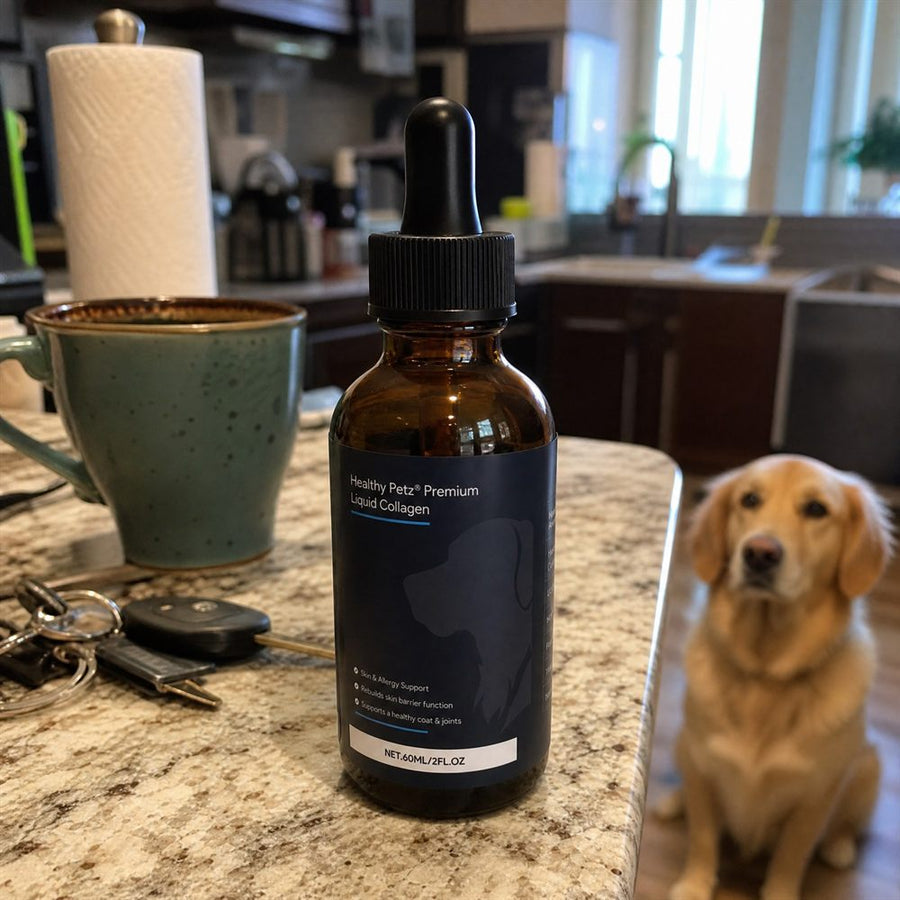
Healthy Petz Premium Liquid Collagen
Hydrolyzed marine collagen, in liquid form. Mix into food once daily. Tasteless, dogs don’t notice it.
- Per 1 mL serving
- 900mgHydrolyzed Collagen Peptides, Types I & III
- 40mgUC-II
- 400mgOmega 3
- 50mgVitamin C
Keep whatever your dog is on now. Add it to dinner, and give it the full eight to twelve weeks.
Get your free bottleUnder $1 a day · 60-day money-back guarantee · free shipping on bundles
Only sold on their own site. If you see it on Amazon or eBay, it isn’t them.
What the next three months actually looked like
I’m going to be honest about this part, because I nearly gave up twice, and I’ve since learned that almost everyone who gives up does it in the same two weeks.
- Week 1
Nothing. Not a thing. The wall is being supplied, not rebuilt yet.
- Week 2
Still nothing, and a couple of rough nights on top. I had the refund email half written. This is the week most people stop. If you’re here, keep going.
The week most people quit - Week 3
The first real change. The evening chewing got shorter. Not gone. Shorter. She’d start, then give up on it.
- Week 4
She stopped going back to the same paw over and over. I’d lie awake at 1am listening for the thump of her leg. Fewer. Longer gaps.
- Week 6
Clean ears. I’d been checking every morning out of fourteen months of habit, waiting for the brown gunk. Pink. Clean. Again the next day.
- Week 8
The hot spot on her belly closed, and nothing new opened up anywhere else.
- Week 12
Her coat. The thing I hadn’t even been hoping for.

Around month three I sat down with our own vet and we started reducing, slowly, the way I’d been told. Not cold. Not because I read something. Because her paws and ears had settled.
So please. Stop trying to fix it.
Not because your dog doesn’t deserve better. Because fixing the itch was never going to fix the wall. Keep the medication doing its job on top. Give the wall what it’s made of underneath. And give it the full eight to twelve weeks.
You’ll hear it before you see it. The silence at one in the morning.
Get your free bottleUnder $1 a day · 60-day money-back guarantee · free shipping on bundles
P.S. If your dog is young and it’s only just started, start now. There’s almost nothing to undo yet, and the wall is easier to rebuild than to rebuild twice.