Vet Warning: The Hidden Skin Barrier Collapse Behind Your Dog’s Allergies (And Why Every Medication Eventually Fails)
“If your dog has chronic scratching, paw licking, hot spots or ear infections, they all share the same root cause. And it’s not the one you’re being treated for.”
 Dr. Claire Hollis, Holistic Vet18 years in small animal practiceUpdated September 2026

Your dog doesn’t have allergies. Not the way you’ve been told.
For most of my career, I treated itchy dogs exactly the way I was trained to. Apoquel. Cytopoint. Steroids for the bad weeks. A food trial. A medicated shampoo. Come back in six weeks.
And the same dogs kept coming back. Same paws. Same ears. Same red belly. Every year, a little worse.
It bothered me enough that I started keeping notes. Every itchy dog I saw, every treatment, what worked, what faded, and when. Years of them.
When I finally sat down and read them back, the same patterns were staring at me from every page. Patterns nobody had pointed out to me in any textbook or lecture. And they all led to the same place.
Not the pollen. Not the food. Not the immune system.
The skin itself.
And nearly 80% of the allergy treatments owners are sold don’t even touch it.
The discovery
The first thing I noticed was where.
Dog after dog, the problem was in the same places. The paws. The belly and groin. Inside the ears. The armpits. And almost never the middle of the back.
That made no sense if this was about pollen and grass. That’s exactly where it all lands. If the itch were following the allergen, the back should have been the worst place of all.
It was following something else. The thinnest skin on the body.
It’s following the thin skin.
The second thing was when. Owner after owner told me the same story: “She was perfect as a puppy. Then around two, it started.” And from there, every year was worse than the last. That isn’t how a simple allergy behaves. Something was changing in the dog over time.
The third thing was how every treatment failed. Not straight away. They all worked at first. Apoquel for a few weeks, then a higher dose. Cytopoint for eight weeks, then six, then four. A new food, a new shampoo, a new supplement: two good weeks, then back where we started. The hot spot healed, then reopened in exactly the same place. The ear cleared, then came back a month later.
Different dogs, different breeds, different treatments. The same pattern every single time.
Something underneath was getting worse while we kept treating the surface.
That something is the skin barrier.
What the skin barrier is
Your dog’s skin is a wall.
The skin cells are the bricks. The natural oils between them are the mortar. And the whole wall sits on a foundation of collagen, types I and III.
When that wall is intact, it does its job silently. Pollen, dust mites, grass, the yeast that lives on every dog: all of it stays on the surface. The immune system never meets any of it. Nothing reacts. Nothing itches.
But the foundation doesn’t last. After dogs stop growing, they lose 7–10% of that collagen every year. Nothing in their food puts it back in a form the skin can use.
Some dogs lose it faster. Goldens, labs, bulldogs, Frenchies and westies are genetically set up to break down sooner. Years of scratching, repeated antibiotics and poor food speed it up even more.
Pollen, dust mites, grass, the yeast that lives on every dog: all of it stays on the surface.
Small gaps open, then bigger ones. Everything that used to sit harmlessly on the surface starts getting into living tissue.
The wall thins. It thins first where the skin was thinnest to begin with: the paws, the belly, the ears. Small gaps open, then bigger ones. Everything that used to sit harmlessly on the surface starts getting into living tissue.
And the immune system does exactly what it’s built to do. It attacks.
That attack is what you’ve been treating as “allergies.”
Suddenly, everything I’d seen in those notes made sense. Why it’s always the same places. Why it starts around two. Why it gets worse every year. Why every treatment works, then fades. Why the same hot spot keeps reopening.
It was never a list of separate problems. It was one wall, collapsing in different places.
Your dog’s immune system isn’t broken. It’s been fighting through a wall with holes in it.
It doesn’t start severe
Not every dog with a failing barrier is scratching itself raw. Most don’t start that way.
In the early stages it looks like nothing much. Licking the paws after a walk. A scratch behind the ear in the evening. A pink tinge on the belly every spring.
A slightly smelly ear you clean once a month. Most owners put it down to “just what dogs do.”
That’s the wall beginning to thin.
Left alone, it keeps going. The licking becomes nightly. The pink becomes red. The ear becomes an infection. The seasonal flare stops going away when the season ends.
Wherever your dog is on that line, from the odd lick to the cone and the steroids, it’s the same wall. The difference is only how far it’s gone. And the earlier you rebuild it, the less there is to undo.
Why every treatment eventually fails
Once you understand the wall, it becomes obvious why nothing held.
Apoquel?
Suppresses the immune response. The barrier keeps collapsing underneath, so every month more gets through and the same dose has more to hold back.
Failure.
Cytopoint?
Blocks the itch signal. The barrier keeps crumbling. That’s why the shot that lasted eight weeks now barely lasts four.
Failure.
The new pills, Numelvi and Zenrelia?
Same approach, new name. Still nothing for the wall.
Failure.
Steroids and antihistamines?
Quieten the alarm. The wall stays broken.
Failure.
Changing food?
Takes one trigger away, so you get two good weeks. The gaps stay open, and everything else keeps pouring through. If your dog is “allergic” to chicken, then salmon, then lamb, it was never the protein.
Failure.
Shampoos, sprays and ear drops?
Clean the surface and clear the infection that’s already there. The wall underneath is untouched.
Failure.
If you’ve spent thousands and felt like you were going crazy, you weren’t. The treatments were never designed to fix this.
Why nobody told you
Here’s what made me angry.
Skin barrier breakdown in itchy dogs isn’t new. It’s been studied for years. But it never made it into the ten-minute appointment.
Because there’s no prescription for rebuilding a wall. No tablet. No injection. No recurring appointment every six weeks. The appointment is built around the prescription pad, and structural repair isn’t on it.
So owners get the shrug instead. “Some dogs are just like this. We’ll keep managing it.”
There’s no recurring revenue in fixing the problem. There’s a fortune in managing it.
So how do you rebuild a wall?
Once I understood the wall, the question changed completely. Not “how do I quieten this dog’s reaction?” but “how do I rebuild the foundation it’s reacting through?”
Think about what the barrier actually needs. The foundation is collagen, and that’s what’s been disappearing. The mortar is the natural oils that seal the gaps between the cells. And while all of that rebuilds, the inflammation has to be calmed enough for the skin to heal instead of being torn open every night.
Rebuild the foundation, seal the mortar, calm the fire. Miss any one of the three, and the wall doesn’t hold.
What I tried first
I didn’t go straight to collagen. I tried everything that looked like it should work.
- Barrier creams and sprays.They sit on top of the skin. You can’t rebuild a foundation from the outside, and on a dog that licks, half of it is gone in an hour.
- Fish oil on its own.It helps the mortar. But pouring mortar onto a foundation that’s crumbling doesn’t make a wall. The dogs improved a little, then stalled.
- Bone broth.Lovely food. Wildly inconsistent, and nowhere near enough of anything to rebuild skin.
Every one of them was treating one piece of the wall. None of them rebuilt the foundation.
How collagen actually rebuilds skin
That sent me back to the research on collagen, and it’s the part that made everything click.
When the right kind of collagen is broken down small enough, into what are called hydrolyzed peptides, it doesn’t just get digested like a piece of meat. The peptides pass through the gut wall into the bloodstream and travel to the skin.
Once they arrive, they do two things. They give the skin the raw building blocks it needs to rebuild the collagen foundation. And they act as a signal to the skin’s own collagen-making cells, telling them to start producing again.
In other words, the right collagen doesn’t just patch the wall. It gets the dog’s own body rebuilding it.
That’s why it works where everything else fails. It’s the only thing that goes after the part that’s actually missing.
But there’s a catch. And it’s the reason most owners who “tried collagen” saw nothing.
Then I tested the collagens
I asked my clients to bring in the collagen products they were already giving their dogs. Then I went through them one by one.
The chews were first to go. A chew is heated to make it a chew, and heat damages the protein. Whatever survives gets digested in the stomach long before it can reach the skin. Most had a tiny dose buried in a “proprietary blend” anyway.
Failure.
The powders were next. Better, but underdosed, full of fillers, and most were only one collagen type.
Failure.
Human collagen from the supermarket. Mostly bovine or chicken, which are two of the most common triggers in itchy dogs. Putting them into a dog whose skin is already reacting makes no sense.
Failure.
The liquids from Amazon. Some looked almost identical to the real thing. When I looked properly, they were underdosed, missing collagen types, or not hydrolyzed at all. One was barely more than flavoured water.
Failure.
By the end I had a clear list of what actually has to be true for collagen to rebuild a dog’s skin barrier:
- It has to be liquid and hydrolyzed, so it’s absorbed instead of digested. Liquid peptides get up to 98% absorbed. Chews and pills manage 20–30%.
- It needs all three types. Types I and III rebuild the barrier structure. Type II calms the inflammation driving the itch.
- It needs the mortar and the cofactor with it. Omega 3 to seal the barrier, and vitamin C, because the body can’t turn collagen into new skin without it.
- And it has to be marine. Not chicken, not beef.
The only one that passed
Only one formula I tested ticked every box: Healthy Petz Premium Liquid Collagen.
So I started using it in my practice. And the results stunned me.

In a group of 147 dogs with treatment-resistant skin and allergy problems, 141 showed noticeable improvement within 6 to 8 weeks.
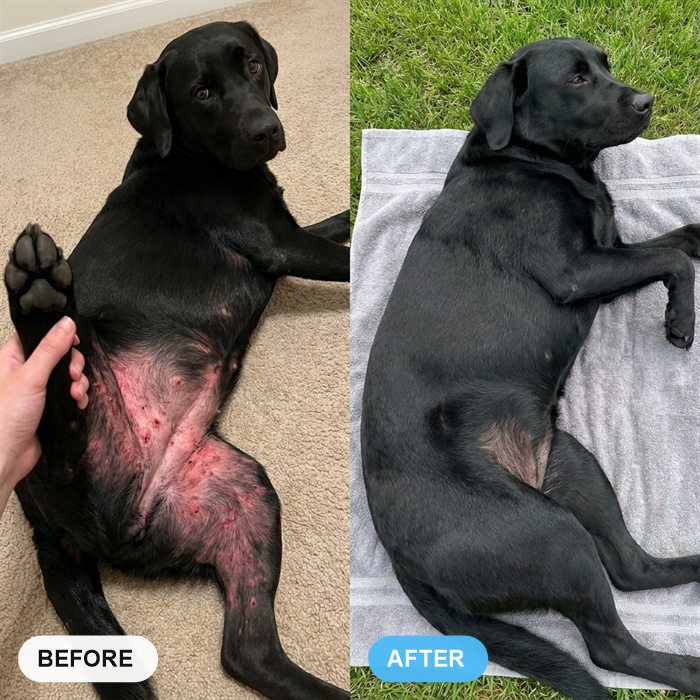
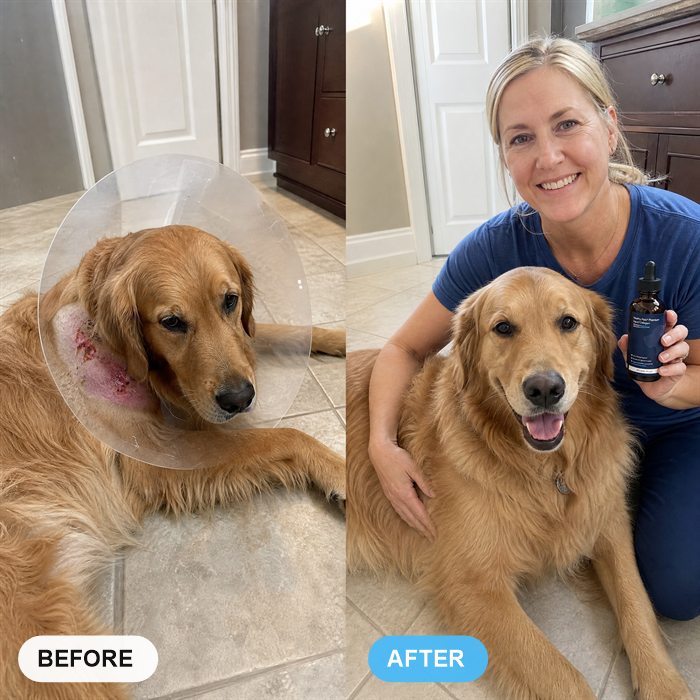
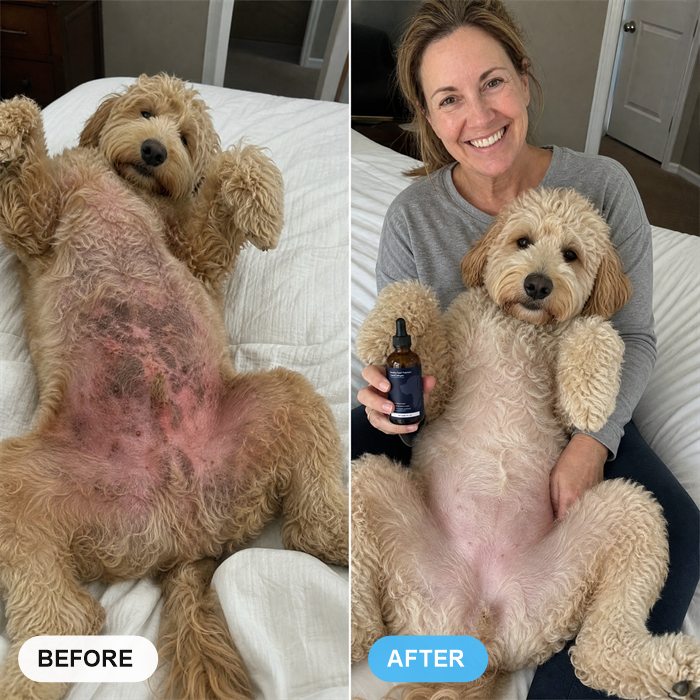
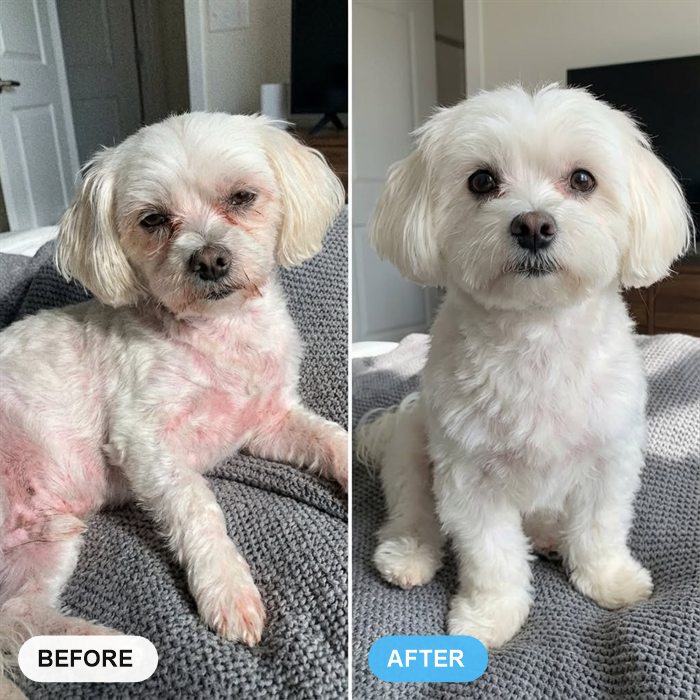
Less scratching. Less paw licking. Hot spots healing, some for the first time in months. Ear infections that stopped coming back. Raw skin turning pink again. Hair growing back in bald patches.
One of them was Bella, a six-year-old labrador. Two years of Apoquel, Cytopoint on top, four food changes, ears infected every six weeks. We kept her on her medication and started rebuilding the wall underneath it. By week six her ears were clean at the recheck, the first clean recheck in a year. By week ten we were bringing the Apoquel down. Slowly.
Her owner handed me the folder of receipts she’d brought to every appointment, and told me to keep it. She didn’t need it anymore.
What’s in it
Here’s exactly what’s in every dose of Healthy Petz Premium Liquid Collagen, and what each part does for the wall.
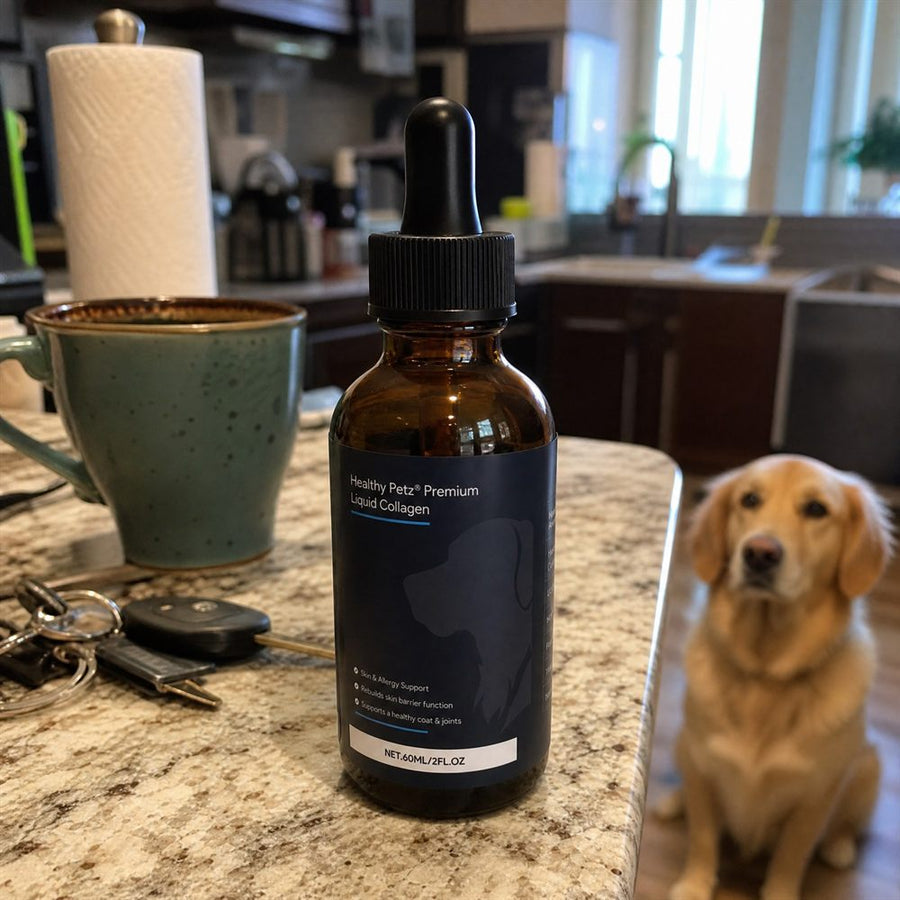
Healthy Petz Premium Liquid Collagen
- 900mgHydrolyzed Collagen Peptides (Types I & III)rebuilds the foundation of the skin barrier.
- 40mgUC-II (Type II Collagen)calms the inflammation driving the itch, at the source.
- 400mgOmega 3the natural oils that seal the barrier and lock in moisture.
- 50mgVitamin Chelps the body turn collagen into new skin tissue.
Marine collagen. No chicken, beef, dairy or fillers. Every batch third-party tested. Only sold on their own website. The look-alikes on Amazon aren’t the same product.
Get your free bottleWhat happens as the wall rebuilds
Keep your dog on whatever they’re on now. The medication keeps them comfortable while the wall rebuilds underneath. Once things settle, talk to your vet about bringing it down.
- Weeks 1–2
The barrier is being supplied, not rebuilt yet. This is where most owners quit. Don’t.
- Weeks 3–4
The evening scratching and licking get shorter.
- Weeks 5–6
Paws and ears start to settle.
- Weeks 8–12
The belly, the hot spots, and the coat grows back.
The wall takes eight to twelve weeks to rebuild. One bottle won’t get you there, which is why most owners start with the multipack.
Cheyenne J.“I have tried everything for my dog’s complicated skin, switching food 100x, cytopoint injections, every medication under the sun. My dog is a puppy again.”
Roan, Labrador“Sampson has been on the collagen going on 3 months and the scratching and licking has greatly reduced to where he almost doesn’t scratch anymore. Don’t be fooled by the fake collagen on the market.”
Connie P.“Even with the Apoquel, she needed Benadryl twice a day during high pollen days. Last night we all slept all night for the first time since we adopted her. She has stopped shaking her head and licking her paws.”
Your decision
You can keep treating the reaction. Keep changing food, keep raising the dose, and accept that this is something you manage forever.
Or you can rebuild the wall it’s all been coming through.
Healthy Petz is running Buy 2, Get 1 Free and Buy 3, Get 2 Free, with a 60-day money-back guarantee.
Liquid formulas take far longer to produce than cheap chews, and every sale wipes out stock faster than they expect. If you’re going to do it, do it while the offer’s running.
Get your free bottleTo your dog’s comfort,Dr. Claire Hollis, Holistic Vet
P.S. If your dog is only at the licking-after-walks stage, start now. The barrier is far easier to protect than to rebuild, and there’s almost nothing to undo yet.